Matthew Paul Thomas
3 July 2017
Designing build.snapcraft.io
In January, I was presented with a design challenge. Many open-source software developers use GitHub. Let’s make it as easy as possible for them to build and release their code automatically, as a snap software package for Ubuntu and other Linux systems. The result is now available to the world: build.snapcraft.io.
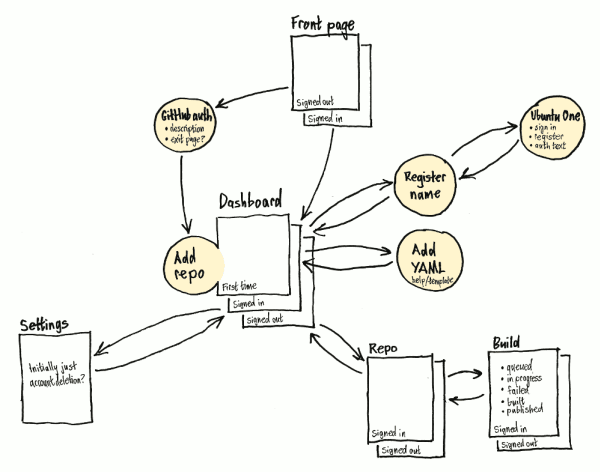
My first task was to interview project stakeholders, getting an understanding of the data and technical constraints involved. That gave me enough information to draw a basic user flow diagram for the app.
Next, I worked with visual designer Jamie Young to produce a “competitor analysis” of software CI (continuous integration) services, such as Travis, AppVeyor, and CircleCI. These are not actually competitors — our app works alongside whichever CI service you use, and we use Travis ourselves. But we weren’t aware of any existing service doing auto-building and distribution together. And CI services were useful comparisons because they have many of the same user flows.
Our summary of good and not-so-good details in those services became the basis for a design workshop in February, where designers, engineers, and managers worked together on sketching the pages we’d need.
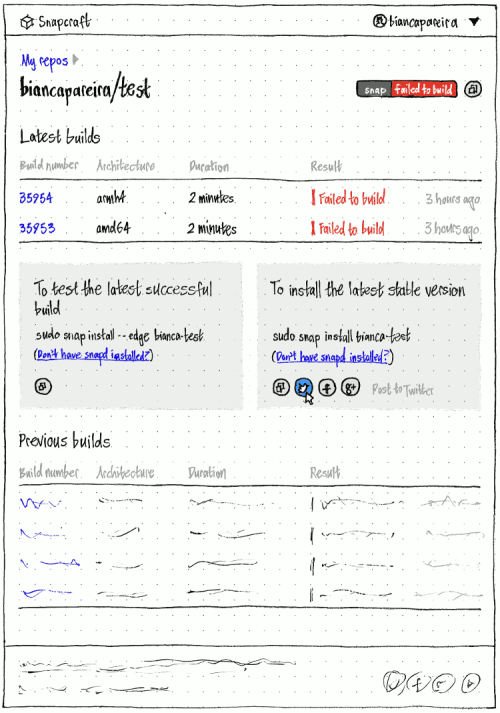
My design colleague Paty Davila distilled these sketches into initial wireframes. I then drew detailed wireframes that included marketing and instructional text. Whether wireframing and copywriting are done by the same person or different people, doing them in tandem can reveal ways to shorten or eliminate text by improving layout or visual elements. I also wrote a functional specification describing the presence, contents, and behavior of each element in the site.
| A sketch of the front page, one of several produced during the workshop. | My minimal wireframe, including text. | Several iterations later, a mockup from Jamie Young. | The front page as it is today. |
 |
 |
 |
 |
The design patterns in Canonical’s Vanilla CSS framework, for basic components like headings and buttons, made it possible for engineers to lay out pages based directly on the wireframes and functional spec with little need for visual design. But in a few cases, visual designers produced mockups where we had good reason to diverge from existing patterns. And the front page in particular benefited from illustrations by graphics whiz Matthieu James.
The most challenging part of designing this service has been that it communicates with four external systems: not just GitHub, but also the Launchpad build service, the snap store, and the Ubuntu One sign-on service. This has required special emphasis on handling error cases — where any of the external sites behave unexpectedly or provide incomplete information — and communicating progress through the overall flow.
Since launching the site, we’ve added the ability to build organization repos, making the service more useful for teams of developers. Once a repo admin adds the repo to build.snapcraft.io, it will show up automatically for their colleagues as well.
I continue maintaining the specification, designing planned features and addressing new constraints. As well as improving design consistency, the spec helps smooth the on-ramp for new developers joining the project. Engineers are working on integrating the site better with the Vanilla framework. And at the same time, we’re planning a project that will use build.snapcraft.io as the foundation of something much bigger. Good design never sleeps.
Meanwhile, if you have code on GitHub yourself, and this snap thing sounds intriguing, try it out.